

Blog
How can there be water where there is none?


Available solutions for local water shortages
Finding an adequate solution for drinking water supply is a challenge for many global organizations and the governments of countries affected by water shortages. Decisions are usually made based on lobbying and economic interests, which often take less account of health and environmental sustainability considerations. There is an enormous amount of money available in the developed world, but unfortunately, these mega water projects often fail to deliver the expected results.
Desalination of seawater is a necessary but painful solution
Desalination of seawater plays an important role in alleviating water shortages, but the technology poses several environmental challenges. The desalination process is widely used around the world, from Israel to the countries of the Arabian Peninsula, remote islands and, much to the regret of ecologists, this destructive process is now also present in Europe.

Saudi Arabia is a frightening example of the exploitation of nature
Water is of strategic importance, as there is virtually no surface freshwater in the country. Thanks to its virtually unlimited financial resources, the kingdom has become the world’s largest seawater desalination power, with daily drinking water production equivalent to the daily volume of global oil production. They operate the world’s largest desalination infrastructure, with more than 40 systems on the coasts of the Red Sea and the Arabian Gulf. On an annual basis, for example, they produced more than 2 billion m³ of fresh water in 2023. According to recent data, the current total capacity is 9.4 million m³/day, and the government’s goal is to reach a capacity of 16.2 million m³/day in the coming years. https://saudipedia.com/en/production-of-desalinated-water-in-saudi-arabia?utm_source=copilot.com

Desalination Plant in KSA
More than 50% of the drinking water supply in Saudi Arabia, with a population of 37 million, comes from desalinated water. Thanks to the advanced infrastructure, the population has access to water at a fraction of the cost through a nationwide pipeline network, thanks to state subsidies. This is despite the fact that producing a single cubic meter of water costs more than USD 10 and building 1 km of pipeline costs the country’s budget around USD 3 million. And it’s not just about money: unfortunately, marine life is slowly disappearing within a 50-60 km radius of desalination plants due to the extremely high salt concentration.
Main environmental impacts
Based on research, the most significant adverse effects occur in the following areas.
High energy consumption and carbon dioxide emissions
Most desalination plants use significant amounts of energy, often from fossil fuels. This contributes to greenhouse gas emissions and global warming. [EBSCO](https://www.ebsco.com/research-starters/oceanography/environmental-impacts-desalination)
Ecological damage caused by inflowing water
When seawater is introduced, tiny marine organisms such as fish larvae and plankton can be sucked into the intake vents and killed. This can have a long-term impact on the balance of local ecosystems. [iere.org](https://iere.org/how-desalination-impacts-the-environment/)
Return of concentrated salt solution (brine) to the sea
A by-product of desalination is brine, which has a high salt content and often contains chemicals. Returning this to the sea can alter local salt concentrations and temperatures, which can harm marine life, especially species that live on the seabed. [EBSCO](https://www.ebsco.com/research-starters/oceanography/environmental-impacts-desalination)
Use of chemicals
Various chemicals are used to clean membranes and treat water. If these are not handled properly, they can also pollute the environment. [Iris Publishers](https://irispublishers.com/ojees/pdf/OJEES.MS.ID.000507.pdf)
Conclusion
Rich countries struggling with water shortages have embarked on a path to secure their drinking water supply that leaves a huge ecological footprint on the planet, but desalination of seawater is certainly not a sustainable long-term solution for water supply!
What alternative water sources are available besides desalination?
Desalination of seawater is an essential process for the daily drinking water supply of many countries (e.g., Saudi Arabia, Israel), but it is not the only way to address water shortages.

Atmospheric water generation (AWG) – a new technology
Atmospheric water generators may be one of the most encouraging innovations and alternative solutions to the problem of drinking water shortages!
- condenses water from the humidity in the air,
- does not require a water source or infrastructure,
- provides clean, mineral-enriched drinking water,
- can be completely sustainable when combined with solar panels.
Rainwater harvesting and utilization
- In many parts of the world, this is the cheapest and most environmentally friendly alternative water source.
- Rainwater collected from roofs or paved surfaces.
- Can be made drinkable with appropriate filtration and UV treatment.
- Particularly effective in monsoon or seasonal rainfall.
Greywater recycling
- Approximately 60-70% of domestic wastewater is greywater (from showers, sinks, washing machines).
- After treatment, it is suitable for irrigation, toilet flushing, and industrial use.
- Significantly reduces drinking water demand.
Reclaimed water – advanced technology
- After membrane filtration, UV treatment, and ozonation, drinking water quality can be achieved.
- Singapore, Israel, and California are leaders in this field.
- Stable, predictable water source even during dry periods.
Managed aquifer recharge (MAR)
- Rainwater, river water, or treated wastewater is returned to the ground,
- thus recharging depleted aquifers,
- natural filtration processes improve water quality.
Fog and dew collection
- Works particularly well in mountainous, coastal or desert areas.
- Large nets or special coatings trap the fog,
- providing tens of liters of water per day,
- A passive solution that requires no energy.
Water import and transport
- Expensive and logistically complex, used in certain places (e.g. Sicily)
- Water transport ships, tankers, tank trucks
- Water pipelines from distant countries
- iceberg towing (at an experimental level).
More about atmospheric moisture
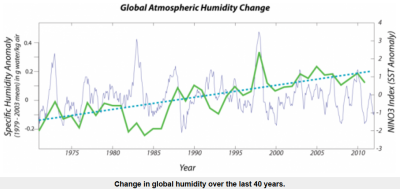
PennState University has written a study on the increase in atmospheric moisture due to global warming. While traditional water sources are drastically decreasing, the amount of water vapor stored in the Earth’s atmosphere is constantly increasing. This is because water evaporates faster when it is warm, so a warmer planet means more evaporation, which adds more energy to the atmosphere. Warmer air can hold more moisture than colder air. According to the laws of thermodynamics, a 1°C increase in air temperature should theoretically increase the atmospheric water content by up to 7%. Until recently, it was difficult to measure the global water content in the atmosphere, but with the advent of satellites and supercomputers, it can now be estimated accurately.
An inexhaustible source of water from the air
In a continuous cycle, approximately 12-16,000 km3 of fresh water is stored in the form of vapor in the Earth’s atmosphere, which is equivalent to the water volume of the Great Lakes of North America, the largest natural freshwater reservoir on our planet. One cubic meter of air (depending on humidity) contains an average of 4-25 grams of water vapor. In theory, current AWG technologies are capable of condensing approximately 20-30% of atmospheric moisture into drinking water.
Technology for extracting atmospheric water vapor
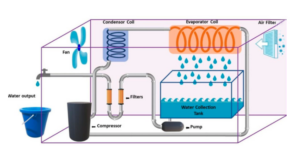 The idea is not new: the Incas, Persians, and other ancient civilizations extracted moisture through various passive processes. Many people believe that condensation also comes from air conditioning, so this is not a major innovation. The average person does not think about the fact that condensation water is contaminated and distilled water is not drinkable at all! So water must not only be extracted from the air, but also made suitable for human consumption, which has strict requirements. Exceptionally at the end of a multi-step water treatment process do we obtain healthy drinking water! Only advanced water industry technologies, composite and RO filters, the use of UV light, as well as efficient heat pumps and microprocessor-controlled atmospheric water generators are capable of providing good quality healthy drinking water.
Individual water supply solutions
Providing community water supply is a state/municipal task, but such investments often take years to reach the decision stage, not to mention implementation.
Most people who visit us are surprised when I offer them a glass of delicious water produced by our own atmospheric water generator.
If you are open to innovation and want to become independent from water suppliers, you can now ensure your own healthy and always fresh drinking water with an atmospheric water generator.
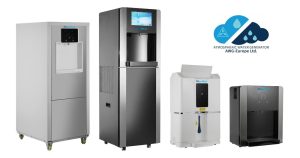
Choose the WizzWell atmospheric water generator that best suits your needs!